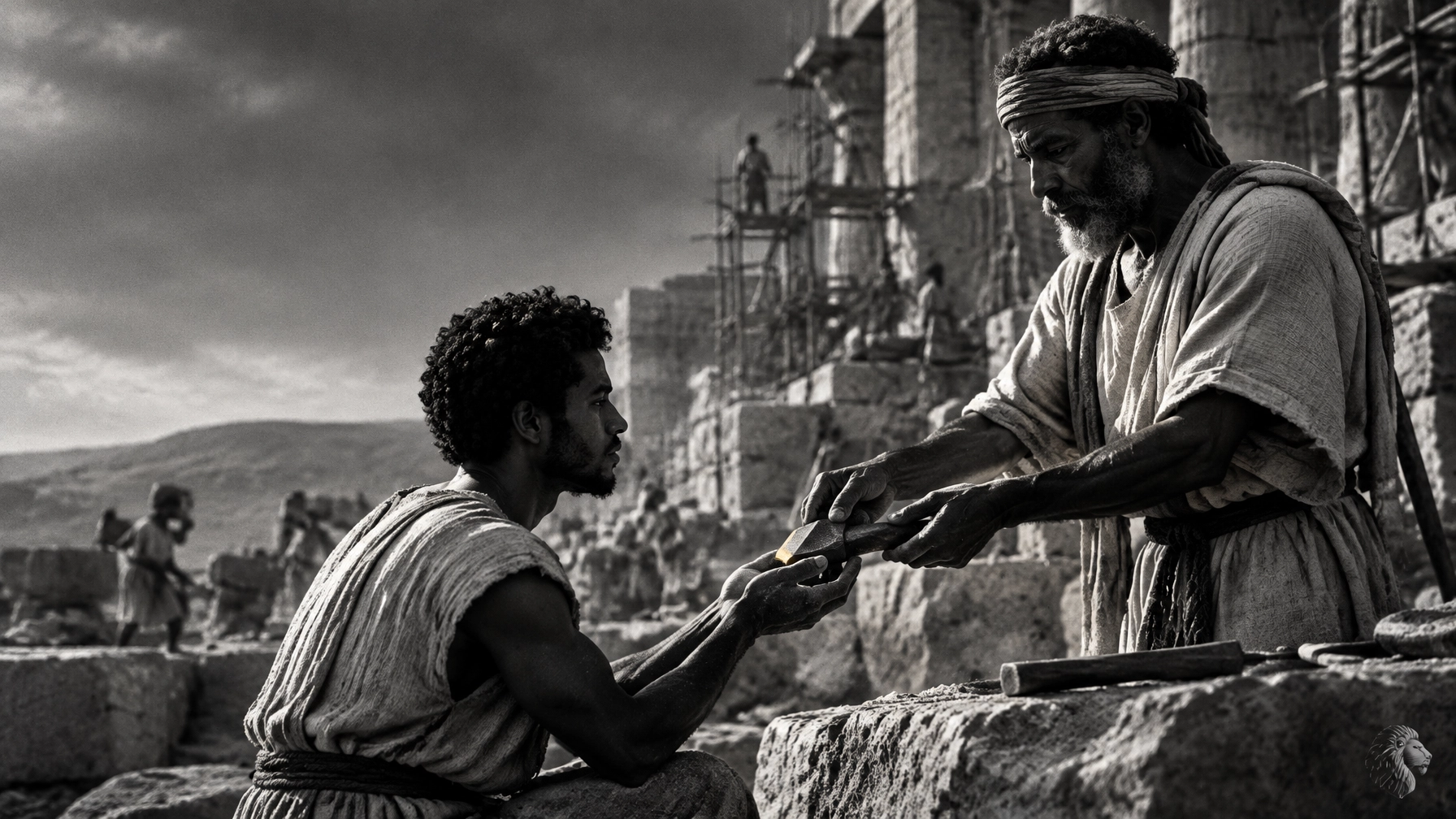
A leader’s real output is not only what they produce. It is who they leave capable of producing.
That distinction separates a visible role from a durable legacy. Followers may admire your work, repeat your language, and wait for your next instruction. Successors learn the standard, carry real responsibility, and become equipped to build without depending on your constant presence.
That is the practical work of biblical mentorship: transferring capability with care. Not collecting loyal spectators. Not creating a personal fan base. Raising people who can carry the assignment, strengthen the work, and prepare others in turn.
For a Kingdom Builder, succession is not an emergency plan to write when departure is near. It is part of the architecture from the beginning. If the work matters, then the people who can carry it forward matter too.
The biblical examples are varied. Mosheh (Moses) publicly commissioned Yehoshua (Joshua). Betsal’el (Bezalel) was equipped to teach skilled work. Sha’ul (Paul) told Timotheos (Timothy) to entrust what he had learned to people able to teach others. These accounts are not one universal formula. They do, however, point toward a core leadership responsibility: develop people, transfer standards, and make the work less dependent on one person.
This is how we reclaim the Monday-to-Saturday build for the Kingdom. Work is worship, and one form of that worship is preparing people to carry responsibility with skill and integrity. Built Different. Called to More. The Avodah Ecosystem exists to help builders turn ambition into aligned, sustainable action, not simply to look influential while the bench remains empty.
Here are seven protocols for raising builders instead of collecting followers.
1. Name the successor before you need one
Succession designed under pressure is usually rushed. People are selected because they are nearby, available, or familiar, not because they have been prepared for the work. A stronger architecture starts earlier: identify potential and begin building capability before a handoff becomes urgent.
In Numbers 27:18–23, Mosheh (Moses) is directed to bring Yehoshua (Joshua) before Eleazar and the community, lay hands on him, and commission him publicly. The passage presents a deliberate transfer of responsibility, not a private scramble to fill a vacancy. Deuteronomy 31 adds public encouragement and preparation for the work ahead.
Relevance: Mosheh’s commissioning of Yehoshua shows that leadership transition can be made visible and intentional. The point is not to imitate every detail in a modern workplace, but to take preparation and clarity seriously.
Start by naming the roles, not crowning a favorite. Identify the responsibilities the work must carry if you are absent for a week, a month, or a season. Then identify who might be developed toward each responsibility. This keeps succession tied to the mission rather than to personal likeness.
David’s charge to Shlomo (Solomon) in 1 Chronicles 28 offers another useful detail. David passes on more than a title. He shares the vision and the specifications for the work. That distinction matters in any organization. “You’re in charge now” is not a handoff plan. A successor needs to understand what is being built, what must be preserved, and where judgment is required.
Practice it:
- List the responsibilities that currently depend on you alone.
- Name one person who could be developed to carry each responsibility.
- Identify what that person needs to learn before the role can be transferred.
- Clarify which decisions they may make independently and which require consultation.
The goal is not to predict every future turn. It is to make the next person visible to the work before a crisis makes the choice for you.
2. Transfer the standard, not just the task
A task can be copied without understanding. A standard can be carried into situations the original leader never anticipated.
If you ask someone to “run the meeting,” you have assigned an action. If you explain why the meeting exists, how decisions are made, what quality looks like, and how to record commitments, you have started transferring a protocol.
Exodus 35:30–35 describes Betsal’el (Bezalel) as gifted for skilled work and able to teach. The passage concerns craft and construction, not a direct leadership succession from Mosheh. Still, the emphasis on both ability and teaching makes a practical point: expertise becomes more valuable when it can be shared.
Relevance: Betsal’el’s skill is described alongside an ability to teach. For builders today, that is a reminder not to hoard craft knowledge that others need to do good work.
Document the work in a short standard operating procedure, or SOP. It does not need to be impressive. It needs to be usable. Include the purpose, sequence, decision points, quality bar, common errors, and where to ask for help. Then demonstrate the task, let the learner practice, and revise the SOP with what the process reveals.
A useful handoff document answers five questions:
- What outcome does this task serve?
- What steps must happen, and in what order?
- What does “done well” look like?
- What can be adapted, and what cannot be skipped?
- What should someone do when the situation falls outside the usual pattern?
The learner should also be able to explain the why. If the process changes slightly, they need enough understanding to make a sound decision instead of waiting for permission at every step.
This is Work Is Worship in operational form. Excellence is not only the result on the surface. It is also the way knowledge, judgment, and responsibility are stewarded.

3. Let them carry real weight early
Training that never reaches real responsibility produces spectators with notes. New builders need practice while the stakes are manageable, not only after the consequences become severe.
“Real weight” does not mean throwing someone into a high-risk situation without support. It means assigning work that matters, giving the person authority appropriate to the task, and agreeing on how you will review the result. A useful first assignment might be leading a team check-in, owning a section of a project, coordinating a small event, or presenting a recommendation to decision-makers.
The handoff should have three parts: a clear outcome, a defined boundary, and a debrief. Before the assignment, explain the result you need and the decisions the person may make. Afterward, review what happened: what worked, what surprised them, what they would change, and what support they need next.
Relevance: In Numbers 27 and Deuteronomy 31, Yehoshua is not introduced as a name on a succession list alone. He is publicly commissioned for responsibility. The account supports the importance of a clear handoff, while leaving the details of modern workplace development to practical judgment.
Do not mistake busywork for preparation. If the person can complete the task without understanding the purpose, making decisions, or being accountable for an outcome, the assignment may keep them occupied without developing their capacity.
Build the responsibility in stages:
- Observe: They watch you lead the work and ask questions.
- Practice: They complete one part with your guidance.
- Own: They lead the task while you remain available.
- Review: You examine decisions, results, and lessons together.
- Repeat: They do it again with greater independence.
For higher-stakes work, keep the guardrails explicit. Name the decisions that require escalation, the risks that cannot be accepted, and the people who need to be informed. Support is not the opposite of trust. It is often what makes trust responsible.
4. Build a bench, not a fan base
A single favored successor can reduce continuity to a single point of failure. If that person becomes unavailable, changes direction, or is not suited to a particular responsibility, the work may stall. A bench gives the work more resilience and gives more people a path to grow.
In 2 Timothy 2:2, Sha’ul (Paul) tells Timotheos (Timothy) to entrust what he has learned to faithful people who will be able to teach others. The instruction describes a chain of teaching and capacity, not simply a close relationship between two individuals.
Relevance: The passage emphasizes that what is entrusted should be carried forward by people able to teach. It offers a picture of shared responsibility across generations of learners, while not making every role interchangeable.
Think in terms of capability clusters. Who can facilitate? Who can communicate the vision? Who can manage logistics? Who can coach a new team member? Who can review the quality of the work? Your bench does not need seven people for every role. It does need more than one person to understand the essential functions.
This is also where biblical mentorship meets organizational design. Mentoring cannot stay informal forever if the work affects a team, school, business, or community. Make room for more than one developing leader. Give people distinct responsibilities and shared exposure to the mission so they learn how their work connects.
A simple bench map can show:
- Critical responsibilities.
- Current owners.
- People learning each responsibility.
- Gaps where no one is being prepared.
- The next practice opportunity for each developing builder.
The aim is not to manufacture replicas of yourself. A healthy bench includes different strengths and different perspectives, all oriented toward the same standard. Popularity can create an audience around a leader. Succession creates capable people around the work. If you want to go deeper on why approval is the wrong foundation to build on, Character Over Popularity makes the case directly.
For a complementary framework on disciplined daily execution, see The Kingdom Builder Consistency Protocol.

5. Give the second chance with guardrails
People grow through practice, and practice includes mistakes. But restoration is not the same as pretending a failure had no impact. A second chance should acknowledge what happened, protect the people affected, and set conditions that make responsible growth possible.
Acts 15:36–41 describes a disagreement between Sha’ul (Paul) and Barnaba (Barnabas) about whether to take Yochanan Mark (John Mark) on another journey. Mark had previously withdrawn from the work. Barnabas wanted to take him; Paul did not. They parted ways, with Barnabas taking Mark and Paul choosing Silas.
Relevance: The account shows differing judgments about readiness and a path in which Barnabas continued to invest in Mark. It does not say that all risks should be ignored or that every return to responsibility should look the same.
In practice, a second chance begins with a direct review. What happened? What was the effect? What can be learned? What has changed since? Then define a next assignment sized to the person’s current readiness. If the earlier failure involved missed communication, for instance, the next assignment might include earlier check-ins and a clear escalation point.
Use guardrails that support accountability rather than shame:
- State the responsibility clearly.
- Agree on the check-in rhythm.
- Identify risks and limits.
- Make the consequence of repeated failure clear.
- Review the work on evidence, not on assumption.
Do not confuse compassion with the removal of standards. A person may deserve dignity and a path to grow while still needing to rebuild trust through consistent action. Likewise, a leader may set boundaries without reducing someone to their worst decision.
The aim is not to guarantee an outcome. It is to provide a fair structure in which a person can show whether they are ready to carry more.
6. Stay reachable after the handoff
A handoff is not abandonment. When someone takes on new responsibility, they may need guidance, perspective, and honest feedback. The goal is not to keep control by hovering. It is to remain available in a way that strengthens their judgment.
Sha’ul’s letters to Timotheos and Titos (Titus) show ongoing instruction beyond face-to-face presence. They address responsibility, teaching, conduct, and the challenges of leadership. These letters are not a modern mentoring manual, but they illustrate that guidance can continue through communication and counsel after a person has been sent to serve.
Relevance: Sha’ul’s continued correspondence with Timotheos and Titos offers an example of instruction and encouragement across distance. For present-day leaders, it highlights the value of follow-through without implying that every detail transfers directly to an organization.
Agree on how support works before the new leader is in the middle of a difficult decision. Set a regular check-in for the first phase. Make it clear how urgent questions should be raised. When feedback is needed, give it promptly and specifically. Praise the decision-making process when it is sound, even if the result needs adjustment.
One useful cadence is:
- A brief weekly check-in during the first month.
- A review after the first significant responsibility.
- A monthly conversation about capability and next steps.
- Immediate feedback when a risk or pattern requires attention.
Reachability is not constant availability. Set boundaries that are honest and sustainable. The developing leader should know when they can expect a response, what decisions they own, and when an issue must be escalated.
If focused work would help you prepare training materials or review a new leader’s first draft, Avodah Sound can serve as a listening companion for a deliberate work block. Use the time to create resources that make the next handoff clearer.
The Focus Protocol offers another perspective on protecting the attention required for deep execution. In mentorship, that attention matters: people need leaders who can be present, listen carefully, and respond to the actual work.

7. Measure multiplication, not admiration
Admiration is easy to notice. Capability takes more careful measurement.
A team may praise its leader and still depend on that leader for every decision. A project may look successful while the process remains undocumented and no one else knows how to repeat it. The test is not whether people like your leadership. It is whether the work can continue with sound judgment when you are not in the room.
Track evidence that capacity is transferring:
- Can someone else explain the purpose and standard?
- Can they complete the work without you taking over?
- Can they identify when a decision needs escalation?
- Can they help another person learn the process?
- Does the work remain consistent when you step away?
This is not a demand to become unnecessary in every sense. Leaders still contribute vision, counsel, and direction. But when basic work cannot proceed without one person’s approval, the system is fragile. A strong leader remains valuable without making everyone else dependent.
Review the evidence at set intervals. Ask the learner what they can now own. Ask the team where the process still relies too heavily on you. Ask whether the SOP reflects how the work actually happens. Adjust based on what you observe, not on the comfort of being needed.
For a related reflection on staying faithful to the work itself, read The Long Obedience Protocol. Multiplication also requires a clear view of the work that must continue through ordinary days, changing seasons, and new leadership.
Popularity may draw attention to the person at the front. But a Kingdom Builder’s deeper measure is whether more people can now carry the work with competence and integrity. That is what it means to build a bench instead of an audience.
The Architecture of a Handoff
Biblical mentorship is not a slogan about being influential. It is a practice of transferring responsibility in ways that protect the mission and develop people. Name who may be prepared. Teach the standard. Give real responsibility. Build a bench. Make room for restoration with guardrails. Stay reachable. Measure what others can now carry.
These protocols do not promise a flawless succession or remove the need for wise decisions. They offer a disciplined way to prepare people while keeping the work clear. Mosheh’s public commissioning of Yehoshua, Betsal’el’s teachable craft, Sha’ul’s instruction to Timotheos, and Barnaba’s continued investment in Yochanan Mark each illuminate a different part of that task.
For an Avodahian, Built Different means more than personal drive. It means becoming a person who can build others without treating knowledge as private property. Called to More is not a reason to chase a bigger platform. It is a reason to steward greater responsibility. And Work Is Worship reaches beyond what you personally produce. It includes the standards you model, the knowledge you share, and the people you prepare to carry the work forward.
Vision without execution is fantasy. A succession plan without trained people is also only a document. The architecture becomes real when someone else can take the next responsibility, understand why it matters, and prepare another person to do it well.
FAQ: Biblical Mentorship and Succession
What does biblical mentorship mean in a professional setting?
Biblical mentorship in a professional setting means developing people through example, instruction, responsibility, and honest feedback, while treating work as stewardship. It involves transferring practical capability and sound standards rather than simply asking someone to imitate a leader.
How do I prepare a successor without rushing the handoff?
Start by identifying the responsibilities that depend on one person. Document the standards and decision boundaries, then let a developing leader practice with manageable responsibility and a clear debrief. Increase independence as their demonstrated capacity grows.
What is the difference between a follower and a successor?
A follower may value a leader’s ideas but still rely on that leader to direct the work. A successor has learned enough to carry responsibility, make appropriate decisions, and help others understand the work. The distinction is capacity, not status.
How does 2 Timothy 2:2 relate to mentorship in the Bible?
In 2 Timothy 2:2, Sha’ul (Paul) instructs Timotheos (Timothy) to entrust what he has learned to faithful people who can teach others. The verse is often used to discuss biblical mentorship because it describes teaching that can be passed forward to additional capable people.
Build Your Bench
Use this one-page Bench Audit to turn the framework into a next step: name one person you are actively building; write what you have actually handed them so far; name the next real responsibility you will transfer in 30 days; and name one more person to add to the bench this quarter. Work through the audit as part of the 100-Day Tribal Challenge.
Leave a Reply